WATER AND THE CLIMATE
According to Allen Hunt, global climate and its variability cannot “be understood if impacts of water are neglected.” (Hunt). Water plays a very important role in determining climate worldwide. The largest subsection of water formations that contributes to climate change, holding 96.5% of the water on earth, are the oceans. (Hunt)
For us Americans, one of the most notable effects of climate change in the short term will be the rising of the sea due to melting glaciers. Coastal regions will be negatively impacted by this phenomenon. (NOAA) However, the rising of the ocean is not the most interesting aspect of water when it comes to climate change.
The reason that the ocean is such an important player in climate change is that it is wet. (NOAA). While this seems a simple assertion, it is often not appreciated fully. (NOAA). Because of its phase, liquid water has a very high heat capacity, and an even higher on in its vapor form (NOAA). More evaporation of the ocean occurs as the world heats due to the release of greenhouse gasses. This can be manifest in El Nino events in the Pacific, caused by rising surface ocean temperatures which usually occur on the 3-7 year range of cycle. (NOAA). El Nino events have been occurring with increasing rapidity since the phenomenon of global warming has become a factor in the state of the global environment.
The atmosphere doesn’t have as much heat potential as water. And while we live on land, neither is it a good conductor of heat. (NOAA) It is therefore, we can logically deduce, the qualities of water related to its ability to conduct heat that determines the temperature, and therefore the climate, of a certain region. (NOAA)
As the world has gotten warmer, the past 150 years have seen a rise in ocean temperature. However, this rise is not instantaneous. Heat from the vaporous atmosphere penetrates into the ocean “through a combination of radiation, convective overturning (in which cooled surface waters sink while warmer more buoyant waters below rise) and mechanical stirring by winds.” (NOAA) It can take, when convective overturning occurs, up to 100 years for the surface temperature of the ocean to mirror instantaneous warming precipitating from global warming today. Heat is pulled to the equator, where it is input into the ocean. (NOAA) It then moves to the poles, where heat loss into the atmosphere occurs, causing the melting of polar ice and general heating of the globe. (NOAA) We have seen global temperatures rise at a rate of unprecedented proportions in the past centuries.
The ocean’s waters are the primary way that heat is transferred to land, and surface temperatures that have been warmed by today’s global warming will only start to affect land temperature in 100 years. We’ve already seen a lot of warming, but this will only increase, to a very scary degree, in the coming centuries when the latent heating of ocean water manifests itself on human-inhabited land.
According to Benjamin Santer of the Lawrence Livermore National Laboratory's Program for Climate Modeling and Intercomparison, “When you heat the planet you increase the ability of the atmosphere to hold moisture. The atmosphere’s water vapor content has increased...and natural variability in climate can’t explain this moisture change. The most plausible explanation is that it’s due to the human-caused increase in greenhouse gasses.” (Hunt) More vapor doesn’t just mean more precipitation. It also will, in the coming decades, mean more heat in the atmosphere, and will continue to exacerbate the global warming we’ve witnessed.
The updated Koppen-Geiger system of climatic classification will need to be updated even more as the decades wear on. The scale will continue to be tipped in the favor of the red end of the spectrum, as warming is expounded by rising ocean temperatures.
Global Water Systems Lecture, Allen Hunt
The Role of Oceans in Climate, NOAA Ocean Climate Observation Program
NOTES on WORLD WATER CYCLES from ALLEN HUNT's LECTURE
JUNE 17 WORLD WATER CYCLES
hydrology-how water moves
Earth’s carrying capacity: surpassed in 1970s
water has a lot to do with carrying capacity
WATER
94% SALINE
2.5% FRESHWATER
1% OF FRESHWATER IS SURFACE
OF SURFACE WATER:
70% ICE
20% LAKES
2% SWAMPS
0.5% RIVERS
VULCANIST WATER CYCLE: CARBON STORAGE
STORAGE//FLUX (DYNAMICS OF WATER)
EG HOW MUCH WATER FLOWS INTO OCEAN FROM RIVERS AND VICEVERSA
EG HOW FAST IS WATER FLOWING?
SMALL VELOCITIES = LARGE STORAGE
LARGE SOURCES OF WATER NOT REPLACED READILY
IMPERMEABLE SURFACES INCREASE FLUX (RUNOFF), DETRIMENT STORAGE
HYDROLOGIC PROCESSES GRAPH
PLENTY OF GROUNDWATER FLOWS MAKE IT TO THE OCEAN
PARTICLES (SALTS) ARE INTRODUCED TO OCEAN VIA FLOWS
THEREAFTER, SALT IS EMBEDDED IN ROCK
WATER AND TECTONICS
WATER HAS DIFFERENT PERMUTATIONS
SOME MOLECULES CONTAIN OXYGEN 18, SOME 16
(NUCLEAR LEVEL, DIFFERENT)
(CHEMICAL COMPOSITION, SAME)
EVAPORATED WATER CARRIES CHEM SIGNALS
WATER CONDUCTS AND TRANSPORTS HEAT
2 CYCLES
TECTONIC
SOLAR
ADDITIONAL ROLES OF WATER IN HYDROLOGIC CYCLE
MOST IMPORTANT GREENHOUSE GAS
LATENT HEAT TRANSFER
ABSORBS SOLAR RADIATION
CLIMATIC ZONES ARE DIFFERENTIATED BY WATER (AND ITS HEAT TRANSPORT POTENTIAL)
GLOBAL WATER DISTRIBUTION:
IN ORDER TO UNDERSTAND:
WATER AND CLIMATE
NEOTECTONICS
MOST WATER VAPOR EXISTS AROUND EQUATOR
PACIFIC, SPECIFICALLY, HAS MOST
MAP OF WATER VAPOR DIRECTLY CORRELATES TO SEA TEMPERATURE
OCEAN CURRENTS AFFECT HEAT DIST (ALSO DUE TO TOPOGRAPHY)
WEST HEMISPHERE IS WARMER
CALIFORNIA IS DRY, EAST COAST WET
CORIOLIS EFFECT (CURLING OF HOT WATER)
OCEAN WATER TEMP DETERMINES WHETHER JUNGLE OR DESERT FORMS
WHAT CAUSES SEASONS? TILT OF EARTH
WATER ON EQUATORIAL LAND EVAPORATES
WATER VAPOR RISES ON EQUATOR
PULLS UP WATER OF FROM OCEAN
COOLS OCEAN IN THAT AREA
WATER HEATS AS IT SINKS--HADLEY CYCLE
SAHARA IS A REFRIGERATOR
AT EQUATOR, 1000 MI/HR
AT POLES, SLOWER SPEED
DEFLECTED TO EAST WHEN TRAVELING TO POLES
DEFLECTED TO EAST WHEN TRAVELING TO EQUATOR FROM POLES
TIBETAN MOUNTAIN (HIMALAYAS) CREATES INDIAN TROPIC (MONSOON)
EROSION IN INDIA (SEDIMENT CARRIED BC OF MONSOONS)
FOG VS RAIN
heating at equator and hadley cells (1st half)
cooling at poles (2nd half)
jet stream
waves
failure of jet stream

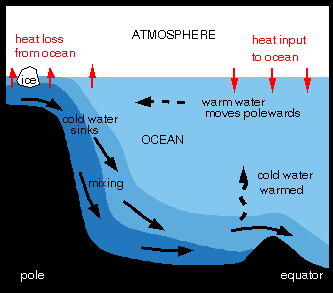
Water is super-heat-conductive, and the oceans are warming quickly.
A schematic of the heat-convective cycle of the oceans.
As can be deduced from this image, the seas are warming rapidly near the equator. This heating will manifest itself at the poles in about 100 years, when the heat will be released into the vaporous atmosphere.
