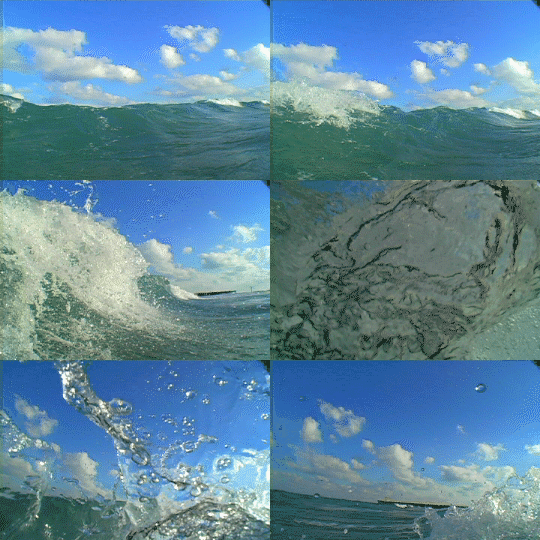
Reflections on Water
Dr. Leslie King's reflections on water were at once scientific and deeply personal. Her personal aproach to recounting her experiences with water were aimed at developing an understanding of how cultural preservation can lead to natural resource conservation and sustainability. (King) While King prioritized organizational and institutional solutions to the problems she cncountered in Latin America, I do not have such knowledge of how to go about conserving our water resources. I've never been to these far away places. But a good way to start the long journey to healthy and sustainable stewardship of Ohio water resources is to reflect on how I've experienced them. Below are two reflections on water. I hope that, like Dr. King's narratives, they are able to emotionally bond people to water and make them consider how important preserving natural water habitats can be.
Central and South American to Dayton Lecture, Dr. Leslie King
POEMS AND THE SEA by Eric Rhodes
Water, water everywhere, but not a drop to drink!”
My mom frequently misquoted Samuel Taylor Coleridge’s famous phrase from The Rime of the Ancient Mariner throughout my childhood, mostly on trips to the ocean. The first time I can recollect her doing so was on a family trip we took to the environs of Kennebunkport, Maine. It’s my first memory of visiting the sea, though I had swum before in my hometown of Silver Lake, in the seemingly vast swells of its eponymous and non-saline lagoon. Summers, if it was a sunny day, consisted of learning to swim in this pond. I would bob up and down in the warm aquamarine for hours. Its antigravity made the infinitely complex martial arts moves of my own fashioning a reality. I could never pull those off out of the water, on solid ground. If it rained, mother would read poems to me. Frost and Thoreau, mainly.
The first time I heard my mother misquote The Rime was in a rental car that was enveloped with a stench similar to that of a high school biology laboratory. My mom, dad, and I had dined on exotically red, spidery sea-creatures the night before in our hotel’s campy restaurant. The smell of butter mixed with the formaldehyde of the car’s liberally-applied all-purpose cleaner as she uttered the passage: I’ll forever associate rental cars with her well-intentioned prose, and with the feeling of utter adventure in my chest that day.
The sky was without clouds. Yellow light and its dark absence warmed and cooled my cheeks in turn as we wound up the coastal pavement through the wood’s ancient blinds of pine. I caught my first glimpse of the tremendous blanket of blue that is the Atlantic through a break in the centuries-old stand on County Road 14.
“North of Cape Cod, it’s too cold to swim in the ocean before May,” she had said as we tuckered in for the previous night.
I was determined to prove her wisdom wrong. I had packed my papery neon trunks, and intended to put them to good use. Who would travel all this way (light years removed from Ohio, in my estimation) and not take full advantage of the topographic idiosyncrasies of our temporary home? Adults were so easily deterred. Why couldn’t I drink the water? I soon found out. With sticky skin, a sour stomach, a and salty pallet, I slept between my parents that night.
There is a picture that hangs on the wall of my parents’ home in Northeastern Ohio, next to the telephone in the kitchen. A shabby and dusty frame, whose cheap gold foil is chipped with age, enclosing a faded Kodak 15-minute print. It, like Coleridge, traces its inception to that day, thirteen years ago. In it, I stand triumphant, hair matted with salt. Skin gleaming wet in the yellow of a sunset. The first time I had held a sea-anemone. A black stone in my hand. No shirt and orange shorts. Far too large for my youthful frame. Sagging. The blue blanket sprawled to my back. And brown sugar at my feet and on my face. Lips upturned. I am invincible. I am happy.
Many years thereafter, in high school, Mrs. Campbell assigned The Rime as our first literary reading. I was happy to be at the academy. To be through with the petty. My new classmates and I were fifteen. We were experienced. I had moved on from the frivolous Language Arts readers of public Middle School to real literature. To art. I had grown up. Sitting at the kitchen table and reading the assignment, I came across the passage.
“Water, water, everywhere,
And all the boards did shrink;
Water, water, everywhere,
Nor any drop to drink.”
And I reached for the phone. I don’t remember seeing the frame or the picture.
I stopped swimming in my teenage years. Silver Lake lost its expanse and its depth. It was nothing more than a dirty pond now. My family and I went on a few vacations to the ocean during my breaks from school, and on them I mostly complained about being away from home. I didn’t bring my swimming trunks with me anymore. The neon orange swimsuit collected dust on the top shelf of my closet.
I was more interested in friends now. Or tans. Or girls. Or beer and cigarettes. Or playing football, or lacrosse. Or getting good grades in my AP classes and getting into the right college. Or social capital. Or something. And I forgot about poems and the sea.
After high school, I studied Politics in London for the year. I missed my mom and my dad. It was hard to wait until the afternoon to hear their tired morning voices crackle through Skype’s protocol and my computer speakers everyday. It was interminable.
I was glad to get home after my scholarship, and to return to Maine with my parents. It would be a quick turnaround. I arrived from Heathrow at nine at night. We would leave for the ocean the next morning. I would have to pack quickly. I opened my closet when I finally returned home. And saw nothing but the bland tract of white paint where my neon used to lie. I asked my mother where they had gone the next morning in the car. She wasn’t sure. The swim trunks must have been lost in the move.
I’ve been looking for them ever since.
WATER, MOTHER by Eric Rhodes
My first interactions with my mother were mediated through water. We all, though we might not remember it, were once encapsulated in a womb full of the stuff. It’s only until we’re ripped from that safehaven that we encounter the atmosphere. But even after birth, the genes Jean Rhodes has passed on to be mandate that I consist of at least 70% hydrogen-2 oxide. What’s the closest analogue to reentering the womb: of enveloping ourselves in water once again? When we’re fetuses, we can’t exist without existing in water. As adults, if we attempt to do so, we’ll most surely drown. Why is this? Why did Edna Pontellier find that the only escape from the turbulence of life was to let the sea carry her away? Did she find safehaven there, in the Gulf of Mexico? Did she meet her maker?
Curious to find out what my maker’s relationship to water was, I sat down with Jean Rhodes, my mother, to find out what her relationship to water was, and whether or not I factored into it.
“My water broke in Borders Books on April 3rd, 1991,” recounted Rhodes, when prompted with my question. “I was looking through a book of baby names with your father when you announced your arrival. It was when I saw the pool forming on the carpet that I let out a shriek and knew that you were on your way to coming into the world. In many ways, my first contact with you was through ‘water.’”
“Luckily,” she continued, “you were healthy enough that we had the ability to take you as you got older on vacations to the beach.” Rhodes mentioned that she was often worried when my father would take me out into the ocean. She was often struck by existential anxiety in these moments. “There’s something about the vast excesses of the sea that make one wary of their mortality, and how easily nature in the form of water can snuff out human life,” she asserted.
“Of course, you spent most of your days down at [Silver Lake] during the summers,” Rhodes recalled. “I think there was something about the proximity to our house that made me less anxious than when you swam in the ocean...Silver Lake helped me let go of you and let you be your own person. I couldn’t always be there, and I had to let you make your own decisions. I remember when you learned to swim. I felt helpless watching you take that swimming test with the lifeguard, but I had to let you do your thing. I wanted nothing more than to hold you and make sure you floated. But sure enough, without my help, you swam; you didn't sink!”
Rhodes spoke about how motherhood changed the relationship she had to water. “I spent most of my 20’s as a hydrologist studying water quality on Lake Geneva in Switzerland, and then Lake Erie not far from here,” she mused. “In a lot of ways, the philosophical and visceral relationship I could’ve had to water was masked by equations, readings, computer screens.”
Rhodes said this changed when she had to consider water and her children. “Of course, seeing you in bodies of water made me fearful at first, but I realized that we human beings have more than a cursory relationship with water. You weren’t going to drown, or at least that wasn’t going to be the only outcome of your water leisure.”
“Water helped you grow up, it made you independent. But not before I was forced to intervene to make sure you were provided for.” I remember my mother, especially during hot summer excursions to main street Hudson, Ohio for shopping, stopping in at establishments to demand of the proprietors free glasses of water for her parched children. “I was probably pretty assertive, but when I really got to see how much water mattered through viewing my kids’ need for it, I didn’t care. Having water to drink is a human right!”
My mother has shown how she loves me by mediating our relationship through water; from nurturing me in her watery womb to indulging in the champagne we sipped when I was accepted to Antioch College. Water isn’t just for drinking, it’s for relating. Love exists in water. I hope we’ll have the privilege of spending many more humid summer evenings by the shores of Silver Lake, sipping diluted limeade together on benches and talking about the things that matter, as the sun dips below the lake’s watery horizon.